# Cert Manager DeSEC Webhook
[](https://github.com/pr0ton11/cert-manager-desec-webhook/actions/workflows/publish-docker-image.yml)
[](https://github.com/pr0ton11/cert-manager-desec-webhook/actions/workflows/publish-helm-chart.yml)
[](https://github.com/pr0ton11/cert-manager-desec-webhook/pkgs/container/helm%2Fcert-manager-desec-webhook)
[](https://github.com/pr0ton11/cert-manager-desec-webhook#supported-architectures)
[](https://github.com/pr0ton11/cert-manager-desec-webhook/blob/main/LICENSE)
[](https://github.com/pr0ton11/cert-manager-desec-webhook/blob/main/go.mod)
Independently maintained ACME webhook for the [desec.io](https://desec.io) DNS API. API docs: https://desec.readthedocs.io/en/latest/
## Requirements
- [go](https://golang.org) >= 1.26.0
- [helm](https://helm.sh/) >= v3.0.0
- [kubernetes](https://kubernetes.io/) >= 1.25.0
- [cert-manager](https://cert-manager.io/) >= 1.19.0
## Supported architectures
- linux/amd64
- linux/arm64
## Installation
### Using helm from local checkout
```bash
helm install \
-n cert-manager \
desec-webhook \
deploy/cert-manager-desec-webhook
```
### Using public helm chart
```bash
helm install \
-n cert-manager \
--version \
desec-webhook \
oci://ghcr.io/pr0ton11/helm/cert-manager-desec-webhook
```
## Creating an issuer
Create a secret containing the credentials
```yaml
apiVersion: v1
kind: Secret
metadata:
name: desec-io-token
namespace: cert-manager
type: Opaque
data:
token: your-key-base64-encoded
```
We can also then provide a standardised 'testing framework', or set of
conformance tests, which allow us to validate that a DNS provider works as
expected.
Create a 'ClusterIssuer' or 'Issuer' resource as the following:
```yaml
apiVersion: cert-manager.io/v1
kind: ClusterIssuer
metadata:
name: letsencrypt-staging
spec:
acme:
server: https://acme-staging-v02.api.letsencrypt.org/directory
email: mail@example.com
privateKeySecretRef:
name: letsencrypt-staging
solvers:
- dns01:
webhook:
config:
apiKeySecretRef:
key: token
name: desec-io-token
groupName: acme.pr0ton11.github.com
solverName: desec
```
## Create a manual certificate
```yaml
apiVersion: cert-manager.io/v1
kind: Certificate
metadata:
name: example-cert
namespace: cert-manager
spec:
commonName: example.com
dnsNames:
- example.com
issuerRef:
name: letsencrypt-staging
kind: ClusterIssuer
secretName: example-cert
```
## Using cert-manager with traefik ingress
```yaml
apiVersion: networking.k8s.io/v1
kind: Ingress
metadata:
name: bitwarden
namespace: utils
labels:
app: bitwarden
annotations:
cert-manager.io/cluster-issuer: letsencrypt-staging
kubernetes.io/ingress.class: traefik
traefik.ingress.kubernetes.io/rewrite-target: /$1
traefik.ingress.kubernetes.io/router.entrypoints: websecure
traefik.ingress.kubernetes.io/router.tls: 'true'
spec:
tls:
- hosts:
- bitwarden.acme.example.com
secretName: bitwarden-crt
rules:
- host: bitwarden.acme.example.com
http:
paths:
- path: /
pathType: Prefix
backend:
service:
name: bitwarden
port:
number: 80
```
## Running the test suite
All DNS providers **must** run the DNS01 provider conformance testing suite,
else they will have undetermined behaviour when used with cert-manager.
Provide a secret.yaml in testdata/desec
```yaml
apiVersion: v1
kind: Secret
metadata:
name: desec-token
data:
token: your-key-base64-encoded
type: Opaque
```
Define a **TEST_ZONE_NAME** matching to your authentication credentials.
```bash
$ TEST_ZONE_NAME=example.com. make test
```
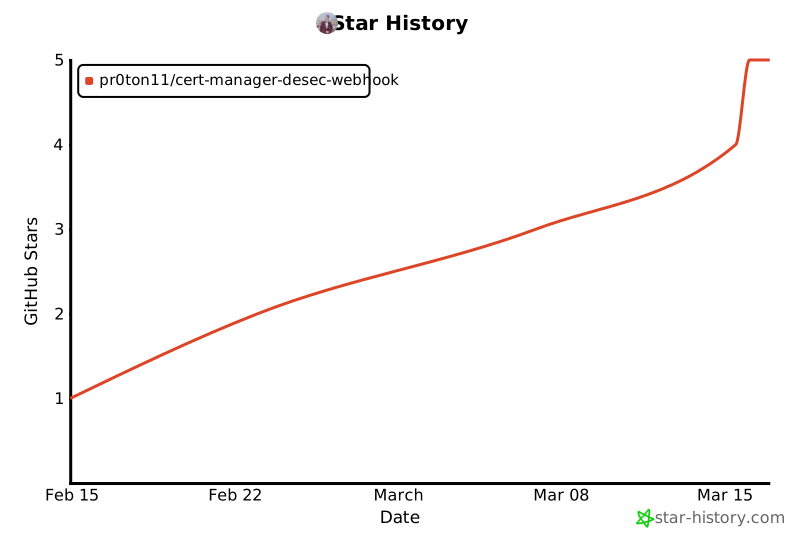
## Stargazers over time
[](https://star-history.com/#pr0ton11/cert-manager-desec-webhook&Date)